.png)
US College Applications: 7 Fatal Mistakes That Will Ruin Your Chances
- Pano Education
- 2 days ago
- 5 min read

During the U.S. college admissions process, many students each year have outstanding credentials with near-perfect GPAs, SAT scores above 1500, participation in numerous research projects, and extensive extracurricular and internship experiences. Applicants often feel confident that their profiles are complete, yet still receive rejection letters. The issue is usually not a lack of effort or ability, but rather that they unintentionally make some of the most common “fatal mistakes” admissions officers see. Below are seven common mistakes and corresponding strategies to help applicants stand out in an intensely competitive admissions landscape.
7 Common Mistakes in U.S. College Applications
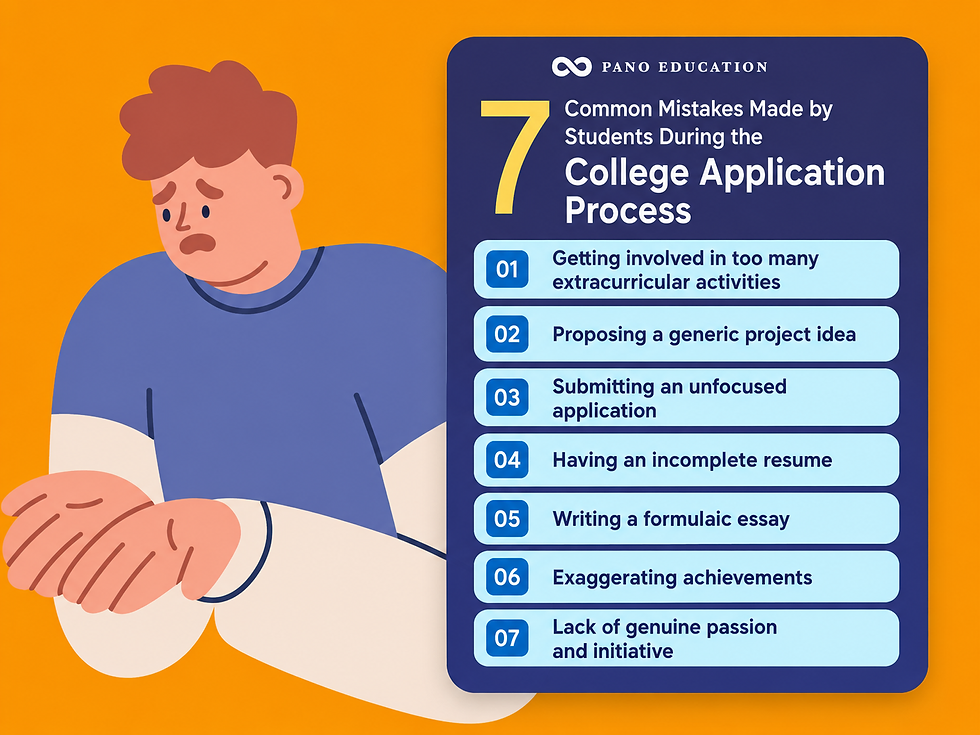
1. Too Many Superficial Extracurricular Activities
Many students try to fill every space on the Common App by joining countless clubs, competitions, or volunteer activities. However, admissions officers care less about the number of activities and more about whether the student demonstrates depth, commitment, and impact. If activities only show participation without genuine investment, admissions officers may question whether the student can manage their time effectively. Long-term involvement that creates meaningful impact is often far more convincing than a long list of shallow experiences.
Focus on Depth Over Quantity
Choose key areas: Focus on 1–2 activities that best represent your interests and strengths instead of spreading yourself too thin.
Show sustained commitment: Demonstrate years of involvement and gradual growth so admissions officers can see consistency.
Create impact: Don’t just participate. Show concrete contributions such as launching initiatives, leading teams, or producing measurable results.
2. Last-Minute Passion Projects Created for Applications
Some students rush to launch an impressive-looking project right before application deadlines in hopes of strengthening their applications. However, admissions officers closely examine timelines. If accomplishments suddenly appear just before applications are submitted, without connections to prior experiences, they can come across as insincere “resume padding” rather than a natural extension of genuine passion.
Plan Early and Build Gradually
College applications highlight long-term commitment, not last-minute efforts.
Explore early: Start experimenting with different interests during freshman or sophomore year.
Deepen over time: Let activities and research grow more advanced as you progress through high school.
If starting late: Even if you begin in senior year, connect the project to existing interests and emphasize your plans to continue it in the future.
3. A Disconnected and Inconsistent Application
A strong application should tell a cohesive story, yet many students submit materials that feel disconnected:
Their essay presents one direction
Their extracurriculars suggest another
Their recommendation letters fail to reinforce either
Admissions officers often spend only 15–20 minutes reviewing an application. If the materials do not quickly communicate a clear core identity or value, the application may seem vague or even contradictory, making it difficult to leave a memorable impression.
Build a Clear Narrative
Choose 2–3 defining traits or interests and ensure every part of the application reinforces them.
Identify your strengths: Think about qualities such as responsibility, creativity, or social awareness that best represent you.
Maintain consistency: Make sure essays, activities, and recommendation letters support one another instead of conflicting.
Leave a memorable impression: Admissions officers should quickly understand and remember your “theme.”
4. Trying to Appear Perfect
Many students worry that revealing setbacks or weaknesses will hurt their chances, so they try to present themselves as flawless. In reality, admissions officers are not looking for perfection. They want to see how applicants handle challenges and grow from them. Stories about obstacles, self-reflection, and personal development often demonstrate maturity and resilience far better than a list of awards and test scores.
Show Authenticity and Growth
Admissions officers care more about your growth trajectory than a perfect résumé.
Acknowledge challenges: Be honest about difficulties or setbacks you’ve faced.
Explain the turning point: Describe how you responded, adapted, and improved.
Highlight lessons learned: Show how these experiences shaped your values and actions.
5. Generic and Forgettable Applications
Admissions officers read thousands of applications every year. Even strong academic achievements can blur together if essays rely on overly common topics such as winning competitions, volunteer experiences, or family stories. These themes are not inherently bad, but without unique details or perspectives, they often become forgettable. The most compelling applications are those that tell stories only you could tell.
Choose Topics That Truly Represent You
Think about which stories best capture who you are, and use vivid details to bring them to life.
Avoid clichés: Common topics can easily blend in if written in a generic way.
Find unique experiences: Reflect on challenges, hobbies, or everyday moments that are distinctly yours.
Use specific details: Describe people, settings, emotions, and experiences vividly so readers feel immersed in the story.
6. Exaggerating or Misrepresenting Experiences
Some students exaggerate their roles in activities. For example, presenting short-term involvement as long-term commitment or describing themselves as founders when they were regular members. This is extremely risky. Admissions officers often cross-check recommendation letters and may even contact mentors or advisors directly. Once dishonesty is discovered, the credibility of the entire application can collapse, potentially affecting admissions decisions.
Present Experiences Honestly
Authenticity is far more persuasive than exaggeration.
Describe real contributions: Even small-scale responsibilities can demonstrate leadership and impact.
Discuss what you learned: Share skills and insights gained through teamwork, problem-solving, or deeper understanding of a field.
Reflect honestly: Acknowledge limitations and explain how you adapted or found new opportunities.
Real experiences demonstrate maturity and potential more effectively than any form of “packaging.”
7. Claiming Interests Without Evidence
Many students claim to be passionate about fields such as medicine, environmental science, or engineering, but their applications lack any related coursework, activities, or projects. Without supporting evidence, these interests can feel unconvincing. Admissions officers want to see proof through academic choices, research, extracurriculars, or independent learning. Interests only become credible when supported by action.
Make Your Interests Visible Through Action
Support your interests with concrete experiences rather than words alone.
Take related courses: Show intellectual curiosity through relevant classes.
Get involved: Join clubs, competitions, or research projects connected to your interests.
Take initiative independently: Pursue self-study, online courses, or personal projects beyond school resources.
Demonstrate continuity: Show that your interest has developed consistently over time, not just temporarily.
For U.S. colleges, the application process is an opportunity to get to know the real you. Many highly qualified students are rejected not because they lack ability, but because they overlook the importance of depth, consistency, and authenticity. Staying genuine, focused, and specific makes an application far more compelling. Admissions officers are not looking for perfection—they are looking for students with individuality, potential, and the capacity to continue growing in college.
**Want to Learn More About Our Programs? **
Feel free to contact us through the following channels:
Official LINE: @panoedu
Phone: 02-8771-3190 / 0912-090-325
、

Comments