.png)
Decoding the Pre-Med Track: Navigating the Journey to Medical School
- JC Guedon
- 1 day ago
- 8 min read


If you are considering a career in medicine, understanding exactly how the journey to medical school works—and how it differs globally—is the crucial first step. Let's unpack what it actually means to be a pre-med student, look at the hard data behind admissions, and map out how to survive the academic, emotional, and financial challenges of the track.
1. The Journey to Medical School, the First Step: What Exactly is "Pre-Med"?
The biggest misconception about being pre-med is that it is a formal major. In the United States and Canada, pre-med is not a major; it is a track. Being a pre-med student simply means you are fulfilling specific prerequisite courses, maintaining a competitive GPA, and gathering the necessary extracurricular experiences required to apply to medical school while simultaneously completing your standard bachelor's degree.
The Graduate Model vs. Direct Entry
In North America, medicine is treated strictly as a graduate degree. You cannot enter medical school straight out of high school. Instead, the journey looks like this:
North American Route: High School $\rightarrow$ 4-Year Bachelor's Degree (Pre-Med Track) $\rightarrow$ 4-Year Medical School
United Kingdom Route: High School $\rightarrow$ 5 to 6-Year Medical School
In contrast to the North American system, the United Kingdom operates on a direct-entry model. Students apply to medical school right out of high school, making their undergraduate degree their actual medical degree.
The British Exception: The only times you will hear the term "pre-med" or "foundation" used in the UK are for highly specific pathway programs. These are typically 1-year preparatory courses designed for international students whose home high school diplomas aren't directly recognized, or for "widening participation" initiatives aimed at students from disadvantaged backgrounds who need to catch up on foundational sciences.
2. Choosing a Major: The Data-Driven Reality
Because pre-med is a track rather than a major, you can major in absolutely anything as long as you finish your medical school prerequisites.
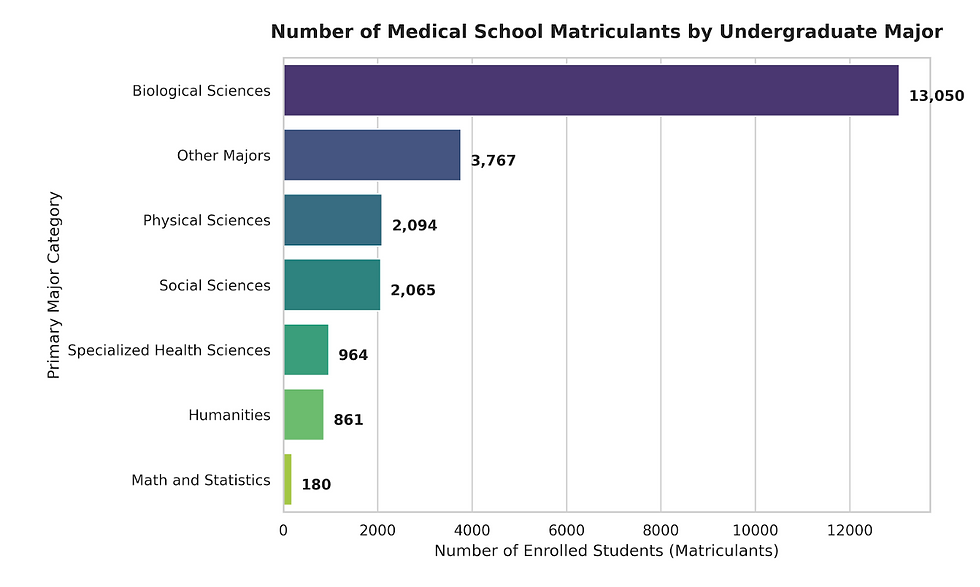
Data from the Association of American Medical Colleges (AAMC) provides a clear picture of how undergraduate majors stack up when applying to medical school. The pathways generally fall into three distinct buckets:

1. Biological Sciences (The Volume Leader)
By sheer volume, biological sciences (molecular biology, biochemistry, neuroscience) dominate the application cycle, accounting for over 56% of all students who successfully matriculate into medical school. The massive advantage here is overlap: your major requirements naturally cover almost all your pre-med prerequisites.
2. Physical Sciences
Majors like chemistry, physics, or engineering demonstrate immense analytical and quantitative ability. However, they can sometimes risk lowering your GPA due to notoriously harsh engineering and physics grading curves.
3. Humanities & Social Sciences (The Strategic Edge)
Psychology, sociology, English, or history majors perform incredibly well in the admissions process. In fact, according to the AAMC, Math/Statistics and Humanities majors frequently boast the highest overall acceptance rates into medical school.
Because fewer humanities and math majors apply, those who do stand out significantly. They bring unique perspectives to admissions portfolios and often excel on the critical reading sections of the MCAT.
The Golden Rule: Major in what you are genuinely interested in. It is much easier to maintain the high GPA required for medical school if you love what you are studying. Medical schools have no preference for your major—they care about your performance.

3. The Academic Baseline: Required Coursework
While specific requirements can vary slightly from school to school, the core pre-med prerequisite courses are highly standardized across North America. You must take these foundational classes regardless of your chosen major:
Subject | Typical Requirement | Why It Matters |
Biology | 1 Year (with labs) | Foundations of cellular life, genetics, and metabolic processes. |
General Chemistry | 1 Year (with labs) | Basic chemical reactions, stoichiometry, and atomic structure. |
Organic Chemistry | 1 Year (with labs) | The complex chemistry of carbon-based life forms. |
Biochemistry | 1 Semester | Highly emphasized on the modern MCAT biological sections. |
Physics | 1 Year (with labs) | Fluid dynamics, optics, electricity, and thermodynamics in biological systems. |
English/Writing | 1 Year | Critical reasoning, essay formulation, and professional communication. |
Math/Statistics | 1–2 Semesters | Statistical analysis for interpreting medical research and clinical trials. |
4. Building the Extracurricular Portfolio: High School vs. College
Medical schools look for well-rounded applicants who have tested their desire to practice medicine in the real world. However, the expectations for your extracurricular profile shift drastically as you transition from high school to college.
[High School: Broad Exploration] ──> [College: Deep Accountability & Core Pillars]
Admissions committees want to see a clear trajectory of growth. In high school, your goal is simply to explore and confirm an interest in science and healthcare. In college, your goal is to prove clinical competency and long-term dedication.
High School Extracurriculars: Exploration & Foundation
If you are a high schooler aiming for a direct-entry program in the UK, a BS/MD program in the US, or simply trying to build a competitive college resume, focus on accessible, foundational experiences:
Hospital or Nursing Home Volunteering: While you won't perform clinical tasks, volunteering at a front desk or transport service proves you are comfortable in a healthcare environment.
Physician Shadowing: Spending 15–20 hours shadowing local family physicians shows great initiative.
Clubs and Competitions: Joining clubs like HOSA (Health Occupations Students of America) or Science Olympiad demonstrates early academic passion.
General Community Service: Food banks, animal shelters, or peer tutoring build a traceable track record of altruism.
College Extracurriculars: The Four Pillars
Once you hit college, the stakes get significantly higher. Medical schools want to see deep, sustained engagement rather than a laundry list of short-term activities. Your portfolio must cover these four pillars:
A. Hands-On Clinical Experience (The Priority): You must interact with patients directly to prove you know what medicine entails. Watching from the sidelines is no longer enough. Consider getting certified as an EMT (Emergency Medical Technician) or CNA (Certified Nursing Assistant), working as a Medical Scribe, or volunteering heavily in free clinics and hospice care.
B. Consistent Physician Shadowing: Aim for 50 to 100 total hours. Mix it up between primary care (pediatrics, family medicine) and specialized fields (surgery, cardiology) to compare how different healthcare systems operate.
C. Research & Inquiry: Whether it is bench (wet lab) research, clinical research with human subjects, or public health data analysis, spending 1–2 years consistently working on a single hypothesis looks spectacular. Note: You do not need to be published to get into medical school, but longevity matters.
D. Non-Clinical Volunteering & Leadership: Work with vulnerable populations (homeless shelters, crisis text lines) and pursue campus leadership roles (Resident Advisor, Teaching Assistant, or club executive).
Key Profile Comparison
Clinical Depth: High school relies on passive observation (guiding patients, front-desk help). College requires active engagement (taking vitals, scribing charts, direct patient care).
Longevity: High school allows for shorter, summer-specific stints. College demands long-term commitment (1 to 3 years in the same organization is highly preferred).
The Quality over Quantity Rule: Admissions committees prefer an applicant who spent three years deeply invested in a single homeless shelter or research lab over an applicant who did ten different activities for two weeks each. Pick what genuinely interests you and stick with it.
5. The Hidden Challenges: Mental, Academic, and Financial Strain
The road to medical school is notoriously grueling. Beyond the intense coursework, the challenges pre-med students face are psychological, structural, and financial.
Part 1: Undergrad Hurdles
The Psychology of Grade Hyper-Fixation: Because admissions are highly competitive, undergraduate pre-meds often fall into a trap of destructive perfectionism. A single bad grade on a chemistry midterm can trigger an intense psychological spiral. This can foster a culture of hyper-competition, turning large lectures into isolating environments.
Chronic Burnout: Balancing a heavy science course load with labs, clinical shifts, and volunteering requires exceptional discipline. Research consistently reveals that mental distress is highly prevalent in medical pathways, with roughly one in three pre-med and medical students struggling with clinical anxiety or severe burnout.
The "Weeder" Curve: Institutions intentionally construct courses like Organic Chemistry to aggressively filter out massive volumes of incoming freshmen, forcing many to adapt their study habits entirely or abandon the track early.
Part 2: The Admission Gauntlet
The $8,000 Financial Gatekeeper: One of the most heavily guarded secrets of the pre-med journey is how expensive it is just to apply. A standard, competitive application strategy involving 20 to 30 schools often balloons into an $8,000 to $10,000 expense when factoring in MCAT prep, registration fees ($355+), primary application fees ($175 for the first school, $47 per additional school), secondary application fees ($50 to $150 per school), and interview travel expenses.
The Holistic Paradox: In the US, having a perfect 4.0 GPA and a top 1% MCAT score guarantees absolutely nothing. Admissions criteria are holistic; you can easily be rejected if an admissions committee feels your personal statement lacks a compelling, authentic narrative.
6. Beating the System: Free Resources and Strategic Planning
The financial burden can be staggering, but you can cut thousands of dollars off your total expenses by leveraging premium open-source study materials and fee waivers.
High-Yield, Free MCAT Prep
You do not need a $3,000 commercial prep course to get a top-tier MCAT score. The pre-med community has built an incredibly robust ecosystem of free, elite-level study resources:
Content Review: Khan Academy offers a completely free, exhaustive video library in partnership with the AAMC. For complex biochemistry or physics, YouTube channels like AK Lectures and Ninja Nerd Science offer college-professor-level breakdowns.
High-Yield Sheets & Docs: The MileDown Review Sheets (a 90-page outline) and the crowdsourced "300-Page Psych/Soc Document" (which transcribes Khan Academy's psychology section) are community-vetted and entirely free.
Flashcards & Active Recall: Use Anki, a free flashcard app utilizing Spaced Repetition Systems (SRS). Download famous pre-made MCAT decks like AnKing or Pankow to study thousands of community-perfected cards.
Practice Passages: Jack Westin offers free daily CARS passages and science question banks designed to mimic the actual MCAT interface.
7. The Timeline: How to Apply to Medical School
The application process is a long, sequential journey that begins a full year before you actually intend to sit in a medical school lecture hall.
[Junior/Senior Year] Take MCAT
│
▼
[May - June] Submit Primary Application (AMCAS/AACOMAS)
│
▼
[July - August] Complete Secondary Applications
│
▼
[September - March] Attend Interviews (Traditional/MMI)
│
▼
[Fall - Spring] Receive Acceptances & Matriculate
1. Take the MCAT (Junior Year / Early Senior Year)
Study for 3 to 6 months and sit for the 7.5-hour exam. Ideally, you want your score back before submitting any applications so you can target your school list accurately.
2. Primary Application (May – June)
Submit your centralized application (via AMCAS for MD schools or AACOMAS for DO schools). This includes your GPA transcripts, MCAT score, a Work/Activities section documenting your extracurriculars, and a core personal statement detailing "Why Medicine?".
3. Secondary Applications (July – August)
Individual medical schools will send you school-specific essay prompts. These require quick turnarounds—usually within two weeks of receipt. Be cutthroat with your school list here; use the MSAR (Medical School Admission Requirements) database to precisely target schools where your GPA and MCAT fit their median data perfectly to avoid expensive "donation" applications.
4. Interviews (September – March)
If a school likes your written application, they will invite you for an interview, which can take the form of a traditional panel or Multiple Mini Interviews (MMIs).
5. Acceptances & Matriculation (Fall – Spring)
Schools issue rolling acceptances. Once you receive your offers, you make your final deposit and begin your medical school journey the following summer.
The pre-med track is undeniably a marathon designed to test your endurance. However, by focusing on a major you genuinely love, protecting your mental health, prioritizing deep clinical experiences over superficial ones, and utilizing free community resources, you can successfully navigate the potholes of the track and cross the finish line into medical school.
**Want to Learn More About Our Programs? **
Feel free to contact us through the following channels:
Official LINE: @panoedu
Phone: 02-8771-3190 / 0912-090-325
、


Comments