.png)
Does being a top student at a "bad high school" give you an advantage when applying to US universities?
- JC Guedon
- Jun 30
- 5 min read


Being a top student at a "bad high school"
In the past two years, I've frequently been asked a tricky question by students' parents:
Should I send my child to a top high school but only get into the upper-middle tier, or should I send them to a regular high school and try to get them first in their grade? Is it worth being a being a top student at a "bad school"?
There is no standard answer to this question. However, I recently came across a post that is quite helpful:
Many students shared their experiences, which can be summarized as follows:
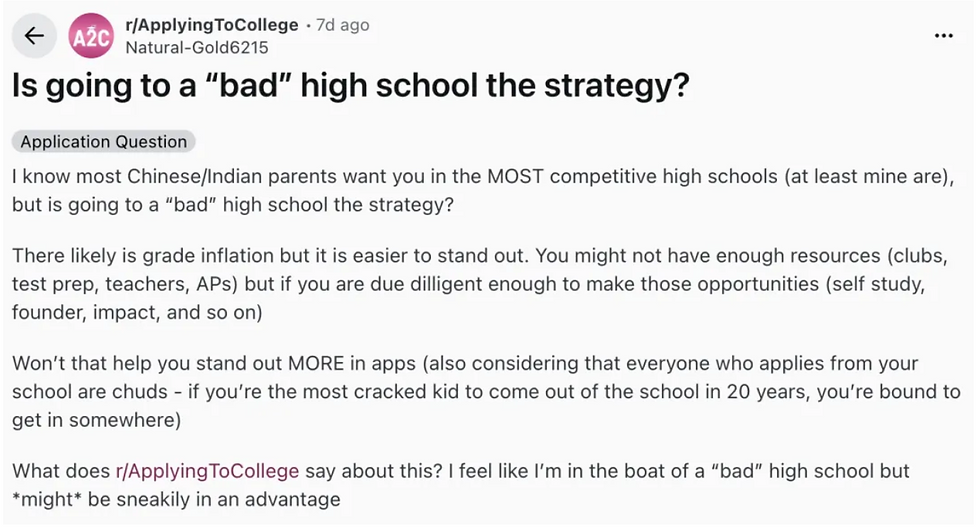
Admissions officers look at the background of your high school.
In other words, while your grades and rankings in high school are important, where you attend high school may be more important than you think.
01 The admissions officer has your high school file.
Let me first explain a mechanism that most students and parents are unaware of.
Before universities evaluate you, they already have your detailed high school record. The University of Pennsylvania, ranked seventh in the US, lists the structure of a high school record on its official website . It is roughly divided into the following parts:
Contact information for the high school principal
Community environment and basic information of the school
Academic curriculum structure
High school grading standards and grade ranking algorithms
Distribution of standardized test scores of students from previous years
Undergraduate Destinations of Previous Graduates
School extracurricular activity resources

what does that mean?
Before admissions officers even see your GPA, they already know which high school you attended. They don't compare high-scoring transcripts from rural high schools with those from top public high schools in Silicon Valley.
This is why some students with excellent grades are inexplicably rejected during the application process. It's because admissions officers evaluate you within the context of the entire school, not just based on your grades.
02 Advantages of top high schools
At this point, some people might think: If I go to a less prestigious high school and get first place, wouldn't that give me an advantage in applying to US universities?
This issue is not so simple. Top high schools have many hidden advantages, which netizens have summarized into the following four aspects:
Abundant academic resources and strong support
If you want to study advanced mathematics, such as variable calculus, in high school, you just need to tell your counselor and gather a few interested classmates. The teacher might even find you a private math tutor. In a regular high school, you'd have to find resources outside of school yourself.
Event Heritage
Some top high schools have large clubs that do impactful work. If you join a club and rise through the ranks, you can share the team's data and results.
Information gap
If you attend a top high school, you're likely to meet upperclassmen who have gone on to enter the top 20. The experiences and lessons they share are far more valuable than anything you could learn on your own.
Academic preparation
Top high schools provide thorough academic preparation for your college entrance exams. For example, American universities often require students to take writing courses right from the start. Students who excel in reading and writing throughout high school are practically guaranteed a spot.
In short, top high schools are not just about test scores; they have a whole system supporting you.
03 The strategy of turning a small pond into a big fish
Does that mean there are no advantages to becoming a leader in a regular high school? Not necessarily, but there are a few key points to consider:
First, you need to make sure you can get into the top 10% of your grade.
Secondly, this strategy is effective if you are applying to the University of California system. Because UC applications don't look at standardized test scores, class rank becomes a crucial factor in the initial screening. If you weren't in the top 10% of your high school, you'll likely fail the first round of screening.

Third, some high schools have never had an offer from Harvard, Yale, Princeton, Stanford, or MIT in their history. You might have to outperform the top student in your year to become a dark horse. It's essentially a gamble.
To put it simply, this strategy is suitable for two types of people.
The first category is students with average grades. If you consistently ranked in the top 15% throughout middle school, but not quite at the very top, attending a regular high school will guarantee you a top ranking, which might give you an advantage when applying to US universities.
The second type is students with very clear goals, determined to get into the University of California system, such as UC Berkeley or UCLA. This strategy might just help you achieve your goal.

04 Comparison of the level of competition among US states
Regardless of individual differences between schools, a ranking of the competitiveness of college applications in various US states has recently circulated online.

The admin summarized the results of the netizens' discussion into a table, making it clear at a glance who the top contributor was.

(Note: The ranking is based on the subjective opinions of American netizens and is not official data. It is for reference only.)
There are three observations worth noting:
First, Texas is far more competitive than people imagine. The Houston and Dallas-Fort Worth metropolitan area has a large number of participants in science and technology competitions and Olympiads, with extremely high selection scores.
Second, Nebraska is a hidden welfare state. Top students who stay in the state to study can receive full scholarships plus living allowances.
Third, the selection score requirements for some scholarships vary significantly across different states in the United States. For example, the score requirement for the Merit Scholarship in Massachusetts, New Jersey, and DC is more than 15 points higher than in some other states.

The admin said
Choosing a high school boils down to asking yourself three questions:
Where do I stand among my peers?
How would the target university view this high school?
Will I be able to adapt after entering high school?
The admin has seen too many families make a binary choice on this issue: either desperately try to get into a top high school, or let an ordinary high school win them the race.
To answer this question well, it's not about which high school is better, but which high school is the best fit for you.
**Want to Learn More About Our Programs? **
Feel free to contact us through the following channels:
Official LINE: @panoedu
Phone: 02-8771-3190 / 0912-090-325
、



Comments