.png)
How to Choose Between Ohio State, University of Wisconsin, and Rutgers


Translated from Traditional Chinese. Original Article linked here.
How to Choose Between Ohio State, University of Wisconsin, and Rutger: Three “Public Ivies”
Ohio State University (OSU), University of Wisconsin–Madison (UW–Madison), and Rutgers University–New Brunswick (RU) often end up as a difficult “pick one-of-three” decision for students. These three strong public universities have similar overall rankings, so how do you find the best fit for yourself?
We analyze these universities through four key dimensions: location, campus life, academic strengths, and career outcomes.
This article focuses on location and campus life, helping you understand the real campus environments. The next part will cover academics and employment outcomes. Stay tuned!
1. Location Comparison
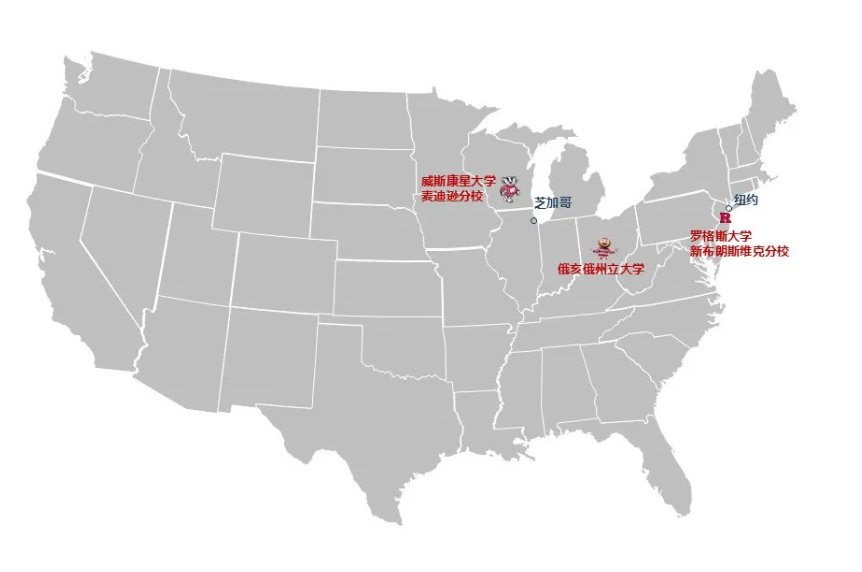
Ohio State University (Columbus, Ohio)
Columbus is the capital of Ohio and the most densely populated city in the state.
Climate: Four distinct seasons. Summer temperatures range from 18–30°C, winter from -6–5°C, with relatively few heavy snowstorms
Population: Nearly 1 million residents. About 58% White, 29% Black, 6% Asian. The greater Columbus metro area has around 2 million people
Economy: Driven by finance, aerospace, energy, technology, healthcare, and food and beverage industries
Nearby cities: About 6 hours by car from Chicago
City characteristics:
The 14th largest city in the US, a fast-growing Midwestern economic hub with relatively low living costs
Strong Chinese community presence, with many Asian supermarkets and Chinese restaurants
Transportation relies heavily on cars, public transit (COTA) coverage is limited
Safety varies by neighborhood, with the area around campus being relatively safe
A livable city, active in minority entrepreneurship, popular among graduates, and known for diversity and LGBTQ+ inclusivity
Location summary: diverse metropolitan city, Great Lakes economic region, low cost of living
University of Wisconsin–Madison (Madison, Wisconsin)
Madison is the capital of Wisconsin and the state’s second-largest city by population. It is also a classic college town.
Climate: Long, cold winters (-10 to 0°C) with heavy snowfall; cool summers (16–28°C)
Population: Under 300,000 residents. Over 70% White, 11% Asian, 9% Black. The greater Madison metro area has nearly 700,000 people
Economy: Centered on information technology, healthcare, manufacturing, and agriculture
Nearby cities: About 2 hours by car from Chicago
City characteristics:
A classic college town and one of the safest cities in the US, with a strong sense of community
Public transit is convenient and the city is very bicycle-friendly, but Asian living amenities are relatively limited
Comfortable and convenient daily life, with plenty of activities such as museums, concerts, and exhibitions
Often ranked as one of the best college towns in the country
Location summary: quiet academic city, snowy climate, safe and convenient
Rutgers University–New Brunswick (New Brunswick, New Jersey)
New Jersey is in the northeastern US. It is highly educated, economically developed, and very diverse. It is the 5th smallest state by area but the 11th largest by population, making it densely populated. It sits right next to New York City and is part of a major metropolitan region. New Brunswick is a mid-sized college city where many people live locally while commuting to work in New York.
Climate: Four distinct seasons, with relatively snowy winters (-6 to 6°C) and comfortable summers (15–30°C)
Population: Under 60,000 residents. 36% Latino, 27% White, 14% Black, 9% Asian
Economy: Mainly healthcare-driven, including the headquarters of Johnson & Johnson
Nearby cities: About 40 minutes to New York City, about 1 hour to Philadelphia
City characteristics:
Part of the New York metro “backyard,” with direct train access to Manhattan in about 1 hour
Dense presence of Chinese restaurants and Asian supermarkets
One of the most expensive regions in the US, with intense off-campus housing competition
Newark Airport in New Jersey offers direct flights from many international destinations
Location summary: New York metro region, cultural diversity, high cost with high access
2. Campus Life Comparison
Ohio State University (OSU) — A “large-scale” world of diversity

If there is one word to define Ohio State University, it is “large.” As one of the largest public universities in the US, it has around 46,000 undergraduates alone. This scale creates a highly diverse and inclusive environment, with abundant clubs, sports events, cross-cultural exchange opportunities, and unique traditions, allowing every student to shape their own growth story.
Campus Life Notes
Student composition: About 60% White, 8% Asian, 10% international students
Moderate academic pressure
A nationally recognized sports powerhouse where athletics are a central part of campus life.
Football games are major annual events, and basketball, wrestling, and ice hockey teams are consistently competitive. The Block O cheer squad is widely known
Over 1,000 student organizations forming an extensive interest network
Housing experience:
First- and second-year students are required to live on campus.
North campus dorms are modern and well-equipped, while some older buildings are in need of renovation.
Students often joke about “dorm lottery,” since quality varies widely
Cost of living: Around $15,000 per year for housing and meals, considered good value
Student feedback:
“In a campus of tens of thousands, finding a niche club of 30 people is surprisingly easy. That kind of precise fit only happens at OSU.”
“Opening the dorm door feels like time travel, either a futuristic apartment or a building from decades ago.”
Campus life summary: sports culture, massive campus events, abundance of resources
University of Wisconsin–Madison: Ice and Fire of Academics and Celebration

Located on the shores of Lake Mendota, the University of Wisconsin–Madison weaves rigorous academics and an energetic lifestyle into a distinctive educational experience. Here, serene lakeside scenery coexists with late-night study lights, alongside a vibrant and youthful campus spirit.
Student composition: 60% White, 11% Asian, 8% Latino, 10% international students
Campus culture:
Strong academic workload with a research-intensive environment
Wide range of class sizes, from 30-person seminars to 300-person lectures (similar dynamics also exist at schools like OSU)
Active party culture, with fraternity and sorority life playing a major role; State Street downtown is a central social hub
Strong athletic identity, especially in football, basketball, and ice hockey, with home games often drawing massive crowds and turning the campus into a high-energy gathering place
Housing experience: First-year students are not required to live on campus, but around 90% still choose to do so
Cost of living: Around $20,000 per year for housing and meals, mid-range compared to peers
Student feedback:
“Here, ‘study hard, play hard’ is built into the DNA.”
“If you want to meet professors, you need to be proactive, then more proactive, and even more proactive.”
Campus life summary: “Work Hard, Play Hard”, party culture, lakeside campusudent composition: 60% White, 11% Asian, 8% Latino, 10% international students
Campus culture:
Strong academic workload with a research-intensive environment
Wide range of class sizes, from 30-person seminars to 300-person lectures (similar dynamics also exist at schools like OSU)
Active party culture, with fraternity and sorority life playing a major role; State Street downtown is a central social hub
Strong athletic identity, especially in football, basketball, and ice hockey, with home games often drawing massive crowds and turning the campus into a high-energy gathering place
Housing experience: First-year students are not required to live on campus, but around 90% still choose to do so
Cost of living: Around $20,000 per year for housing and meals, mid-range compared to peers
Student feedback:
“Here, ‘study hard, play hard’ is built into the DNA.”
“If you want to meet professors, you need to be proactive, then more proactive, and even more proactive.”
Campus life summary: “Work Hard, Play Hard”, party culture, lakeside campustudent composition: 60% White, 11% Asian, 8% Latino, 10% international students
Campus culture:
Strong academic workload with a research-intensive environment
Wide range of class sizes, from 30-person seminars to 300-person lectures (similar dynamics also exist at schools like OSU)
Active party culture, with fraternity and sorority life playing a major role; State Street downtown is a central social hub
Strong athletic identity, especially in football, basketball, and ice hockey, with home games often drawing massive crowds and turning the campus into a high-energy gathering place
Housing experience: First-year students are not required to live on campus, but around 90% still choose to do so
Cost of living: Around $20,000 per year for housing and meals, mid-range compared to peers
Student feedback:
“Here, ‘study hard, play hard’ is built into the DNA.”
“If you want to meet professors, you need to be proactive, then more proactive, and even more proactive.”
Campus life summary: “Work Hard, Play Hard”, party culture, lakeside campus
Rutgers University–New Brunswick: A Modern Melting Pot of Cultures

As one of the oldest universities in the United States, Rutgers University–New Brunswick embodies a philosophy that blends deep tradition with modern diversity. It is both a crossroads of cultures and a hub for academic innovation.
Student composition: 33% White, 28% Asian, 15% Latino, 11% international students
A dynamic balance between academics, social life, and athletics
Academic intensity fluctuates throughout the semester, with a generally manageable daily pace and “all-in study mode” during midterms and finals
Strong multicultural presence, with a wide range of campus events such as concerts and international food festivals
Downtown commercial areas support diverse lifestyles, with global restaurants, specialty bars, and shopping centers
Member of a major athletic conference (including schools like OSU and UW–Madison), with energetic yet relatively approachable football and basketball atmospheres
Housing experience: First-year students are not required to live on campus, except for those in the Honors College
Cost of living: Around $25,000 per year for housing and meals, mid-to-upper range
Student feedback:
“During exam season, the library is like a magnet that pulls even the most distracted students back to their desks.”
“A surreal routine of coding in the lab on weekdays and going to New York for exhibitions on weekends.”
Campus life summary: cultural melting pot, urban lifestyle, balanced student life
✅ Decision Guide: Self-Assessment Checklist
How to Choose Between Ohio State, University of Wisconsin, and Rutgers. Do you already have a sense of these three universities? You can also use the questions below to help identify which one fits you best.
What kind of city size do you prefer?
A) Large Midwestern city vibe → OSU
B) Quiet and safe college town → UW–Madison
C) Suburban satellite city in the NYC metro area → RU
How do you feel about long winters and frequent snowfall?
A) Can adapt → UW–Madison
B) Prefer milder winters → OSU / RU
What type of campus culture do you prefer?
A) Traditional American sports culture → OSU > UW–Madison
B) Academically intense with a strong party scene → UW–Madison
C) Balanced academics and social life → RU
What type of student body do you prefer?
A) More mainstream culture (higher proportion of White students) → OSU / UW–Madison
B) Highly diverse and multicultural environment → RU
What is your budget level?
A) Prioritizing cost-effectiveness → OSU
B) Moderate budget → UW–Madison
C) Comfortable with higher costs → RU
**Want to Learn More About Our Programs? **
Feel free to contact us through the following channels:
Official LINE: @panoedu
Phone: 02-8771-3190 / 0912-090-325
、


Comments