.png)
Don't Wait Until After Applications to Figure This Out: Six Dimensions That Reveal What a US University Is Really Like


Choosing a US university is one of the most disorienting parts of the application process. With thousands of schools that look similar on paper, similar names, similar rankings, similar stated requirements, how do you actually figure out which one fits you? Here are six concrete dimensions worth evaluating what a US university is really like, along with a practical tool at the end that most students never use.
1. What a US University Is Really Like: School Size
Think about how you learn best. Do you enjoy raising your hand in class, interacting frequently with professors, and being assessed through papers and presentations rather than a single high-stakes final exam? Or do you prefer sitting back, absorbing lectures independently, and proving your abilities through a major end-of-term exam or project without needing constant contact with faculty?
US universities span an enormous range. At one end, schools like Williams College and Caltech have classes that sometimes number in the teens, professors who know every student by name, and communities where everyone runs into each other constantly. At the other end, schools like the UC campuses and UT Austin enroll tens of thousands of students, offering vast resources, highly specialized departments, and alumni networks that span every industry and country.
Students who thrive on interaction and close mentorship tend to do better at small liberal arts colleges and elite private universities with low student-to-faculty ratios. Students who prefer independence and can self-direct in a larger environment often flourish at big research universities.
2. What a US University Is Really Like: Location
How do you want to spend your weekends and free time? If your ideal afternoon involves hopping on a subway to visit a museum, grab food from a restaurant you found on social media, or drop into a networking event at a nearby company, an urban school is for you. If your idea of a good Saturday is a picnic on the quad, a hike in nearby hills, or getting fully absorbed in campus life without the noise of a city, a rural or suburban campus will feel more like home.
Location shapes more than your social life. It directly affects cost of living, internship access, and how much of the "college experience" is self-contained versus intertwined with a city around you.
Urban schools like NYU offer immediate proximity to industry, constant stimulation, and enormous variety. The trade-offs are real: higher living costs, less of a traditional enclosed campus, and a social fabric that can feel more diffuse.
Schools in quieter settings tend to have stronger campus community and school spirit. The entire student body lives and eats and studies together, which builds a kind of closeness that large urban schools rarely replicate. The trade-off is that if you need variety and stimulation from outside the campus bubble, you may feel the absence acutely.
3. What a US University Is Really Like: Academic Structure
Do you want someone to hand you a framework, or do you want to build your own? Some students genuinely benefit from a structured curriculum that tells them what every educated person should know, pointing them toward foundational texts in philosophy, science, history, and literature regardless of their major. Others find rigid requirements suffocating, particularly if they want to explore across disciplines from day one, or if their interests don't map neatly onto a traditional distribution model.
Schools with a Core Curriculum, Columbia and University of Chicago being the classic examples, require all students to work through a shared set of foundational courses. Every student reads similar texts, which creates a campus-wide intellectual common ground. The cost is that required courses leave less room to explore your own major early on.
Schools with an Open Curriculum, Brown being the most well-known, impose few or no general requirements outside your major. You follow your interests without a mandatory framework. The upside is freedom; the risk is that students who need structure can drift through four years taking disconnected courses without building a coherent foundation.
4. What a US University Is Really Like: Cost and Financial Aid
Be honest with yourself and your family about finances. Some families need significant aid for any school to be realistic. Others have more flexibility, or are specifically targeting schools wealthy enough to provide top-tier need-based support.
For cost-sensitive families, merit-based scholarships at schools ranked slightly below the very top can be genuinely transformative. A strong applicant at a school like Tulane, Northeastern, or Case Western can sometimes receive enough scholarship money to attend essentially for free, which changes the calculus entirely compared to a school where full-pay sticker price is the only option.
For families targeting need-based aid, the wealthiest private universities, the Ivies, MIT, Stanford, and a handful of others, have enough endowment to meet 100% of demonstrated financial need without loans. The catch: these schools are brutally competitive, and many of them are "need-aware" for international applicants, meaning applying for financial aid can affect admission odds.
5. What a US University Is Really Like: Campus Culture
What does your ideal Friday night look like? If your answer involves wearing school colors to a packed football stadium and an after-party that's genuinely raucous, there are schools built exactly around that kind of electric, sports-centric social life. If your answer is a smaller group of close friends, a board game in someone's dorm room, or a late-night conversation about something that actually matters to you, a different kind of school will suit you better.
Big sports-and-Greek-life schools offer a kind of communal intensity that's hard to replicate anywhere else. The social calendar is full, the school identity is strong, and if you love that environment you will feel completely at home.
More academically oriented schools tend to have quieter, more intellectually focused social scenes. The friendships formed there are often deeper and more selective, and the culture doesn't require you to be constantly "on" socially to feel like you belong.
6. What a US University Is Really Like: Post-Graduation Goals
Where do you want to be five years after graduation? If the answer is a Wall Street investment bank, a Silicon Valley tech company, or a top-tier consulting firm, certain schools have direct recruiting pipelines into those destinations that others simply don't. A strong alumni network in a specific industry can be worth more than a slightly higher ranking.
If your plan is to go straight to a top master's or PhD program, or eventually into academic research or a university career, a different set of schools rises to the top: those with strong undergraduate research programs, faculty who are active researchers willing to write detailed and credible recommendation letters, and cultures that genuinely value intellectual life for its own sake.
The Practical Tool: The Common Data Set

Once you know which dimensions matter most to you, the Common Data Set (CDS) is the most reliable source of data available for evaluating specific schools. Every major US university publishes one annually, and it contains official figures that third-party ranking sites often simplify or misrepresent.
For school size, the B1 and B2 sections of the CDS give you exact undergraduate enrollment numbers, broken down by full-time and part-time status and by gender, as well as how many new students enrolled in the most recent class.
For cost and financial aid, the G section breaks down official tuition, required fees, and room and board charges. The H section tells you what percentage of students applied for need-based aid, how many received it, and how many had their full demonstrated need met.

For campus life and social culture, the F section is particularly useful. It details the percentage of students living on campus, the types of housing available, and the range of extracurricular activities officially offered. This data can help you quickly assess whether a school is primarily residential or commuter-heavy, and whether student life is structured around a traditional campus experience.
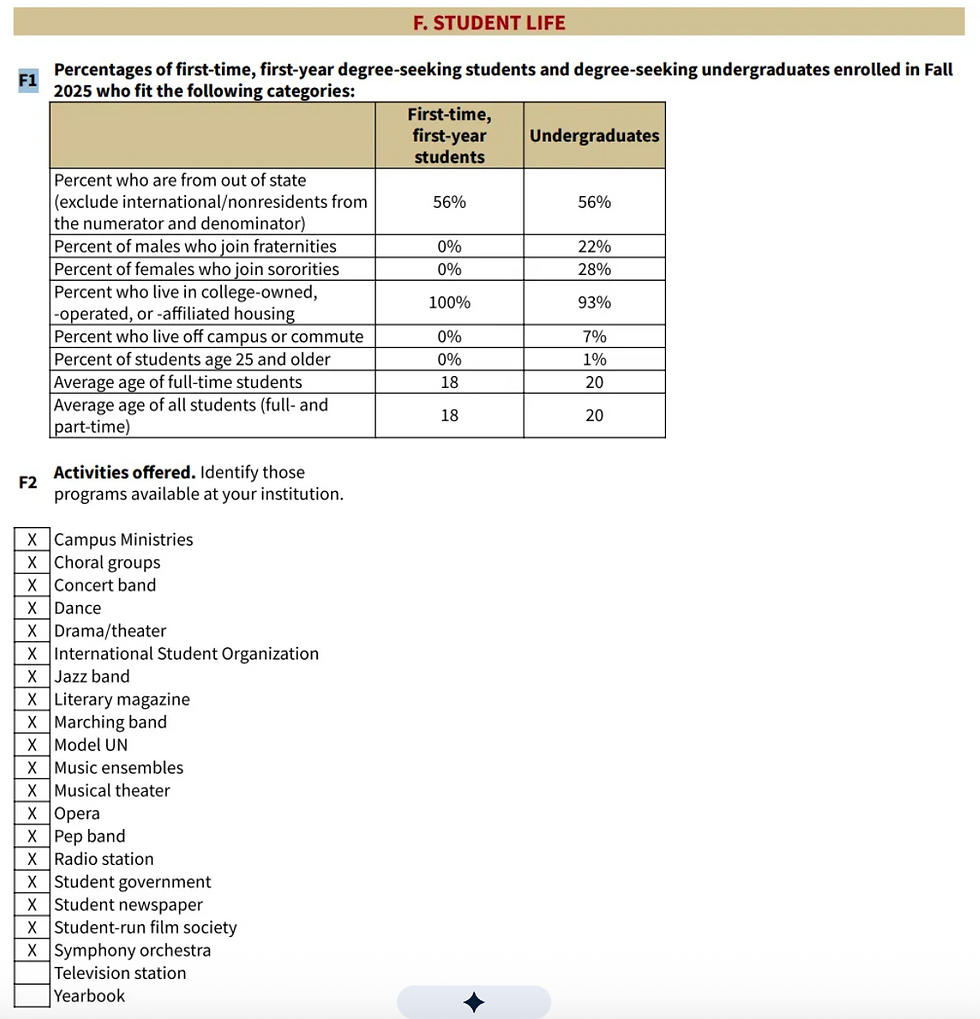
The CDS won't tell you everything, but it will give you a factual foundation that no ranking website or brochure can match. For any school you're seriously considering, pulling up its most recent CDS and reading through the relevant sections is one of the most useful things you can do.
**Want to Learn More About Our Programs? **
Feel free to contact us through the following channels:
Official LINE: @panoedu
Phone: 02-8771-3190 / 0912-090-325
、


Comments