.png)
The Extracurricular Activity Hierarchy That Actually Matters for Top US College Admissions


Here is an uncomfortable truth for students aiming at top US universities: a 1530 SAT and five 5s on AP exams is not enough on its own. Scores open the door to consideration. What actually differentiates applicants at the top tier is the substance and coherence of everything outside the classroom.
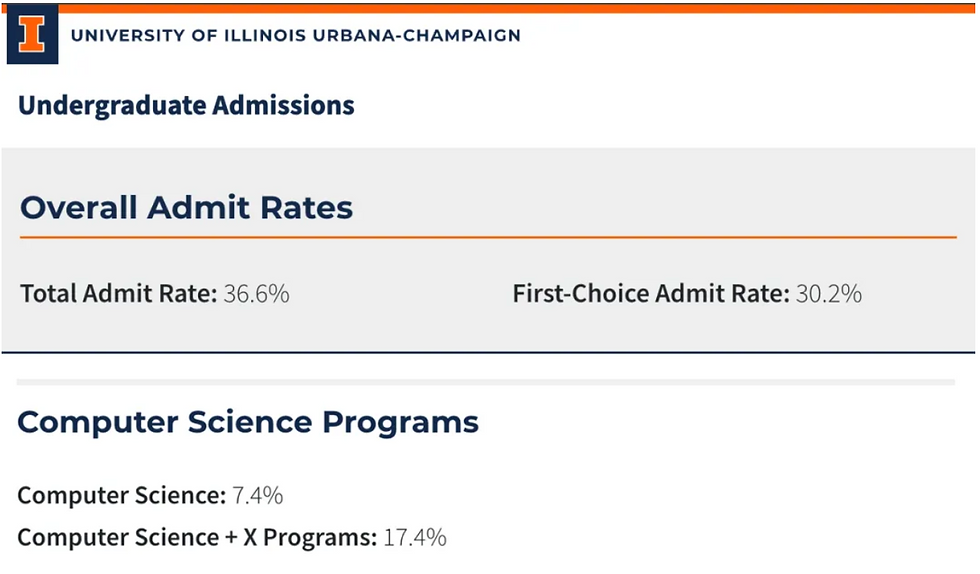
And the stakes are higher than most students realize. UIUC's overall acceptance rate sits around 36.6%, which sounds approachable, but its computer science acceptance rate is 7.4%, nearly five times harder. Cornell Engineering admits around 6.6% of applicants. UC Berkeley engineering comes in around 7%, with computer science even lower. For STEM applicants targeting top programs specifically, the competition is brutal, and extracurricular activities carry real weight in how admissions officers distinguish between candidates with nearly identical academic profiles.
College Transitions published a breakdown of how activities are evaluated in terms of their relative value to admissions. Here is what that extracurricular activity hierarchy actually looks like.
Tier One: Competitive Activities with Verifiable Outcomes
The highest-value activities share one defining characteristic: they produce public, independently verifiable results. You either won something or you didn't. You either published research or you didn't. There's no ambiguity about what the achievement means.
This tier includes performance in olympiad competitions like Physics Bowl, USACO for computing, chemistry olympiads, and mathematics competitions at the regional, national, and international levels. It includes research recognized by programs like ISEF (International Science and Engineering Fair) and similar rigorous scientific research competitions. Winning a gold medal at an international science olympiad, placing in the top rankings of USACO, or receiving recognition at ISEF carries genuine and clear signal about a student's ability.
The reason these activities carry so much weight is that admissions officers at competitive programs can evaluate them objectively. A first-place finish in a national math competition is the same credential regardless of which school is reading it. That clarity and verifiability is precisely what makes these activities the most powerful entries in an application.
One student admitted to UC Berkeley for astrophysics achieved a top-20 global finish in Physics Bowl and a gold medal at the British Physics Olympiad. His advice to STEM applicants: start competing in ninth or tenth grade, but choose carefully. Entering a competition without serious preparation isn't useful and can actually hurt a profile. Fewer competitions pursued seriously are worth far more than many pursued casually.
Tier Two: Substantive Professional-Level Activities
Not every strong applicant will have an international competition medal. This tier captures activities that demonstrate genuine depth, sustained engagement, and real impact, even without a podium finish.
Leadership in STEM Organizations
The key distinction here is not simply holding a title but demonstrating what changed because of your leadership. Creating something new, growing membership, launching a program, solving a problem the organization had, these are the stories that make leadership credible to admissions readers.
One student admitted to MIT co-founded a computer science club specifically for girls, then organized an online Java summer camp to teach coding to younger students for free. The club grew from nothing into a functioning organization with real participants and sustained programming. That trajectory, founding something and building it to operate independently, tells a fundamentally different story than joining an existing club and attending meetings.
College-Level STEM Coursework
Taking courses genuinely beyond high school level demonstrates academic readiness in a direct way. Dual enrollment programs, where students complete courses that simultaneously earn both high school and college credit through partnerships between high schools and universities, are particularly valuable because the credit is transferable and independently verified. Some students enroll in community college courses in advanced subjects specifically to demonstrate capability beyond what their high school offers.
The important caveat is to prioritize courses with genuine academic rigor and transferable credit over prestige-branded non-credit programs. A challenging community college calculus course with a strong grade matters more than a fee-based online "certificate" from a well-known university name.

STEM Internships and Research Work
Hands-on professional experience shows admissions officers that a student has moved from theoretical interest into actual practice. One student admitted to the University of Chicago spent a summer interning at a company working on autonomous driving technology, gaining direct exposure to how mathematical modeling is applied to real-world engineering problems. He described the experience as revealing that mathematics could be used to simplify complex industrial problems in ways he hadn't previously understood. This informed both his academic direction and the intellectual narrative he built in his application.
The value of this kind of experience is that it grounds abstract academic interest in something concrete and demonstrable. It shows initiative, professional engagement, and a willingness to do the work of understanding a field from the inside.

Tier Three: Interest-Based Activities
This is where most students start, and it's a legitimate starting point. Club membership, self-directed learning, and participation in interdisciplinary projects all fit here. The difference between this tier and the ones above is not the activity itself but what a student does with it over time.
One student admitted to Cornell Engineering began with a childhood passion for birds. That interest led her to volunteer at a zoo, then to work at a breeding facility, then to building a community exchange group, then to founding a school club, then to curating a human-nature art exhibition, and finally to joining a raptor rescue team. In her application essay she wrote about not minding being pecked, having her hair pulled, or having birds relieve themselves on her clothing, because every interaction with birds made her feel at ease. That specificity and authenticity aligned naturally with Cornell's emphasis on environmental connection.
The point is not that bird-watching is a powerful extracurricular. The point is that a genuine passion pursued consistently and developed over years into something with clear depth and contribution tells a coherent story that admissions officers can see and remember.
Three Ways to Evaluate Whether Your Activities Are Working
Sustained interest matters more than surface variety. A two or three-year personal research project rooted in genuine curiosity outweighs a scattered collection of unrelated short-term activities. Admissions readers are looking for evidence that interest is real, and real interest doesn't disappear after a semester.
Professional depth needs to be visible. When someone reviews your application, they should be able to see a clear thread connecting your activities, research, coursework, and interests. One student admitted to Pomona College developed a profile that moved from a high school biology dissection experience that sparked her interest, to founding a community support group for Alzheimer's caregivers and conducting field research, to choosing an Alzheimer's-focused project for an international synthetic biology competition. Each step built on the last, and the cumulative picture communicated a specific intellectual identity: someone with genuine scientific curiosity and the human concern to connect that curiosity to real problems.
Effort without visible output is nearly invisible. The most compelling STEM activities produce something concrete: an application that runs, a paper submitted or published, a club that grew or produced measurable results, a student population that was actually helped. One student admitted to the University of Chicago founded a nonprofit tutoring organization that used live-streamed and recorded sessions to prepare students for a major middle school entrance exam, eventually serving five or six hundred students over more than two years of sustained operation. The scale and longevity of the impact made the leadership claim credible.
Extracurricular Activity Hierarchy: The Bigger Picture
Strong STEM applicants at top US programs need more than hard scores. The applicants who stand out are the ones who can connect a thread from genuine interest through sustained engagement to visible impact, and who can show that the pursuit meant something beyond credential-building. Admissions officers reviewing a file in under ten minutes need to be able to answer three questions: who is this person, what do they genuinely care about, and what would they bring to this campus? The extracurricular record, at its best, answers all three at once.
**Want to Learn More About Our Programs? **
Feel free to contact us through the following channels:
Official LINE: @panoedu
Phone: 02-8771-3190 / 0912-090-325
、


Comments