.png)
The Best of Both Worlds: 13 Universities That Feel Like Liberal Arts Colleges Without Sacrificing Research Resources


A common dilemma for college-bound students is the tension between two very different kinds of undergraduate experience. Liberal arts colleges offer intimate class sizes, professors who know your name, and a tight community feel. Large research universities offer depth of resources, specialized programs, and the prestige of a major institution. For students who want both, the choice can feel impossible.
It doesn't have to be. A specific tier of universities manages to deliver the classroom intimacy and community cohesion of a small college while maintaining the research depth, faculty credentials, and professional networks of a major institution. They tend to share three characteristics: undergraduate enrollment in the 5,000 to 8,000 range, a campus with clear physical boundaries that creates a self-contained community, and faculty-to-student ratios below 10:1. Here are the universities that feel like liberal arts colleges without sacrificing research resources.

Universities That Feel Like Liberal Arts Colleges Without Sacrificing Research Resources: Northwestern University
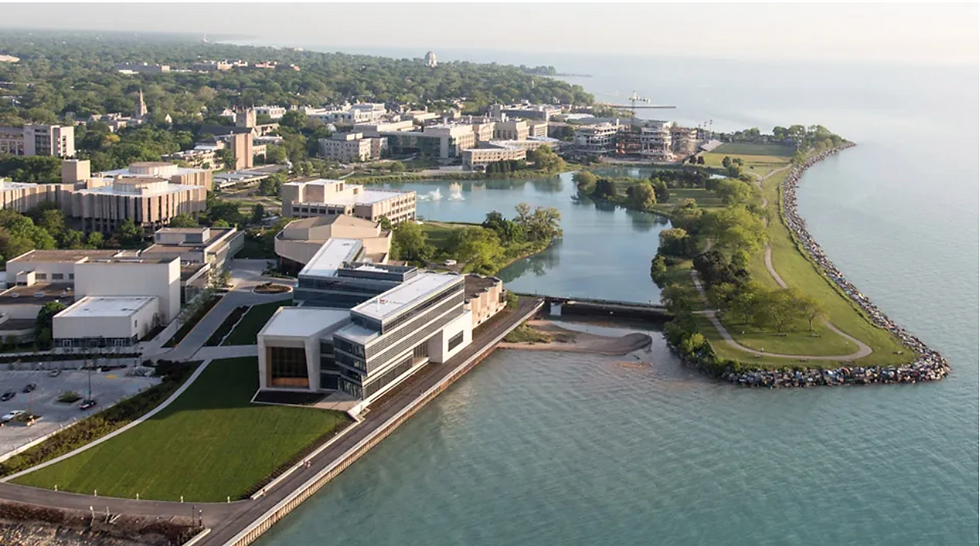
Northwestern is the closest thing on this list to what most people picture when they imagine a comprehensive research university, but it has done an unusually good job of preserving the feel of a smaller academic community within that structure. With just under 9,000 undergraduates and a 6:1 student-to-faculty ratio, it is smaller and more intimate than most of its peer institutions.
The campus itself contributes to this. Situated on the shores of Lake Michigan, the grounds have a particular quality that is hard to explain until you've walked them: a slower pace, a certain openness, a sense that the natural environment is part of the educational setting rather than incidental to it. Fifty-seven percent of undergraduates have the opportunity to conduct research alongside faculty, which is a high figure for any research university and reflects a genuine institutional commitment to undergraduate involvement in scholarship.
For students with clear interests in STEM or journalism who also want a campus environment that breathes rather than grinds, Northwestern is a strong fit.
Universities That Feel Like Liberal Arts Colleges Without Sacrificing Research Resources: Vanderbilt University
Vanderbilt's campus is home to a nationally recognized arboretum, and the physical setting reflects a broader institutional character: 7,300 undergraduates, a 7:1 student-to-faculty ratio, and more than 60% of courses enrolling fewer than 20 students. On paper, those numbers look like a liberal arts college.
Two aspects of the lived experience are worth highlighting. First, the campus sits on the edge of Nashville rather than in the middle of it. Once you walk onto the grounds, the city recedes. The campus has a clear sense of its own contained world, and that geographic clarity contributes to a strong sense of place. Second, more than 90% of undergraduates live on campus for all four years, which creates a level of community density that commuter-heavy universities cannot replicate. When the same people are eating, studying, and living together across four years, the social bonds that form are qualitatively different.
Vanderbilt is a strong fit for students interested in pre-medicine or engineering who also want the sense of living within a close-knit community rather than moving through a large institutional complex.

Universities That Feel Like Liberal Arts Colleges Without Sacrificing Research Resources: Emory University
With just over 8,000 undergraduates and proximity to the Centers for Disease Control and Prevention, Emory is a legitimate research powerhouse, particularly in biology, chemistry, and public health, where its location creates research access that few universities can offer.
Its distinctive feature, though, is the Oxford College campus. Emory's freshman and sophomore students at Oxford spend their first two years at a small separate campus in Oxford, Georgia, where they experience a pure liberal arts college environment: small seminars, 99% residential housing, and meals shared with faculty. After two years, students transition to the main Atlanta campus to complete their degrees.
This structure functions as a genuine soft landing. Students who worry about getting lost in a large university during their first year get exactly the intimate environment that concern is about, with the full resources of a major research university waiting on the other side. For students interested in biomedical science or public health who want a strong start in a smaller setting, Emory's two-campus model is genuinely distinctive.

Universities That Feel Like Liberal Arts Colleges Without Sacrificing Research Resources:University of Rochester
Rochester is a relatively small research university by any measure: around 6,500 undergraduates, a 9:1 student-to-faculty ratio, and 77% undergraduate research participation, one of the highest figures in the country for a research institution. Its pairing of serious engineering and optical science programs with one of the country's top music conservatories under one roof makes it unusual in ways that go beyond the typical research university profile.
The academic structure reflects a commitment to student autonomy. With no core curriculum requirements beyond writing, students at Rochester build their own academic path with unusual freedom. The Take Five scholarship program formalizes this ethos: it allows students to spend a tuition-free fifth year pursuing any intellectual interest outside their major, whether learning an instrument, studying an ancient language, or exploring something entirely unrelated to their professional trajectory.
Rochester suits students who are self-directed enough to use freedom productively, who have specific interests in engineering, optics, or music, and who want to grow at their own pace within a resource-rich environment.

Universities That Feel Like Liberal Arts Colleges Without Sacrificing Research Resources: Tufts University
Tufts was the most frequently cited answer in the discussion that prompted this post, and the reasons make sense once you understand the school's unusual institutional identity. With approximately 6,900 undergraduates, a 10:1 student-to-faculty ratio, and more than 60% of classes enrolling fewer than 20 students, it offers the classroom experience of a liberal arts college. Its engineering school, global study abroad programs, and graduate school placement outcomes match what a serious research university delivers.
The deeper story is about lineage. Tufts is the only research university that is an official member of NESCAC, the New England Small College Athletic Conference, whose other members include Williams, Amherst, Middlebury, and Bowdoin. That membership is not incidental. It reflects how Tufts has positioned itself: with the campus culture, alumni network intimacy, and emphasis on undergraduate teaching that define the best liberal arts colleges, wrapped around the program depth of a comprehensive university. First and second-year students live on campus; class sizes are consistently small; students can design their own courses with faculty guidance.
For students who want the community feel of a top liberal arts college but know they need more than a small college can offer in terms of research infrastructure and professional reach, Tufts is one of the clearest answers available.

Universities That Feel Like Liberal Arts Colleges Without Sacrificing Research Resources: Eight More Schools Worth Your Time
The five schools above are not the only ones that fit this profile. Eight others consistently earn mention in this conversation:
Duke University is widely considered to have one of the most beautiful natural campus environments in the country, with a strong research infrastructure built into a campus that feels enclosed and community-oriented.
Boston College offers a visually stunning Gothic campus with direct subway access to downtown Boston, combining strong community cohesion with urban proximity.
Rice University, located in Houston, has a warm and intimate campus culture that produces unusually tight community bonds for a research university.
Notre Dame is known for an exceptionally strong sense of institutional identity and community that is difficult to find at institutions of comparable size.
Washington University in St. Louis has a beautifully maintained campus that feels like a self-contained small city, quiet and carefully designed.
Brown University is the most open-structured of the Ivy League schools, with a curriculum that gives students substantial freedom to design their academic path.
Dartmouth College is the Ivy with the strongest small-college character, situated in a small New Hampshire town, with a social culture that is active and tightly connected.
William and Mary is one of the oldest public universities in the United States and maintains a campus feel that more closely resembles a private liberal arts college than most public institutions.
The tension between research resources and community intimacy is real, but it is not irresolvable. The schools on this list demonstrate that institutions can be built to deliver both. The key is knowing which qualities matter most to you before you start comparing.
**Want to Learn More About Our Programs? **
Feel free to contact us through the following channels:
Official LINE: @panoedu
Phone: 02-8771-3190 / 0912-090-325
、


Comments