.png)
U.S. Visa Updates: Paid Express Appointments, the H-1B Fee Blocked, and What It All Means for International Students
- JC Guedon
- 4 hours ago
- 4 min read


A lot has happened in the U.S. visa and immigration space recently, and if you are an international student or a family planning for one, several of these changes are worth understanding clearly.
B1/B2 Visas: You Can Now Pay to Jump the Queue
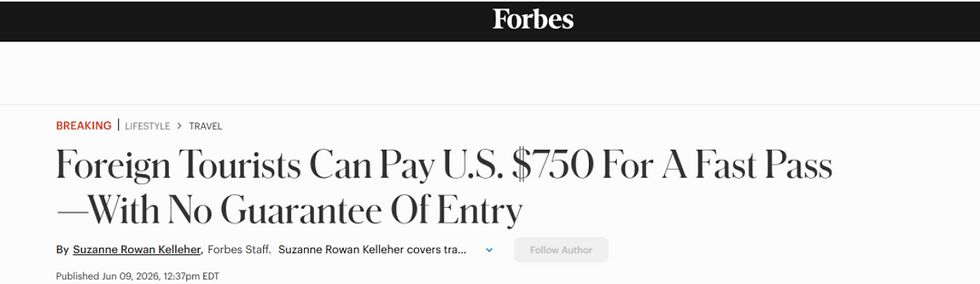
The U.S. Federal Register has announced a pilot program running from July 1 through December 31, 2026: select U.S. consulates and embassies abroad will offer a paid expedited appointment service for B1/B2 visitor visa applicants.
The way it works is straightforward. If an expedited appointment slot is available within the next 10 business days, applicants can pay an additional $750 fee to secure priority access. Since the standard B1/B2 visa application fee is $185, the total cost with the expedited option comes to $935, roughly 6,800 RMB.
Reaction has been mixed. Some people have criticized it as blatant queue-jumping for the wealthy. Others take a more pragmatic view: if it gets you an appointment faster, it might be worth it.
The frustration driving demand for this is real. U.S. visa appointment availability has been notoriously difficult for years. The current global median wait time for non-immigrant visa interviews is around 30 days, but in some locations the wait stretches far longer: Abuja, Nigeria currently sits at around 11.5 months. In Shanghai, appointments as of late May were already booked into September.
One important clarification: the $750 buys you an earlier appointment date, not faster processing or any advantage in the actual visa decision. The consular officer's review criteria are identical regardless of how you got your slot. Paying the fee does not improve your odds of approval.
For international students specifically, there is no need to panic about this change. The pilot is targeted at tourist and business visitors, largely in anticipation of increased travel demand around upcoming major international events. F-1 student visa applicants already have access to their own expedited appointment process at no additional cost, provided they meet the standard criteria: a valid I-20 from their institution, a submitted DS-160 form, paid visa application and SEVIS fees, a program start date within roughly 60 days, and no recent visa refusals on record. That process remains unchanged.
The $100,000 H-1B Fee Has Been Blocked
Last year, the Trump administration announced a plan to charge employers $100,000 per H-1B petition, a figure that sent shockwaves through the tech industry and caused many H-1B workers abroad to rush back to the United States before the policy could take effect.
Due to a federal court ruling the H-1B fee has been blocked entirely. The judge's reasoning was that the charge functions as a tax, and under the U.S. Constitution, only Congress has the authority to levy new taxes. An executive action cannot create one unilaterally. The administration has indicated it intends to appeal, but until a new ruling comes down, employer costs for sponsoring an H-1B remain at the standard level of several thousand dollars, not six figures.

H-1B Lottery Rules Have Changed Significantly
The bigger and more lasting change to the H-1B system is in how petitions are selected. Starting in 2026, the United States is moving away from a fully random lottery and replacing it with a wage-weighted selection system based on OES (Occupational Employment Statistics) wage levels.
Under the new rules, higher-wage positions are processed first. Only if quota slots remain after higher-wage petitions are reviewed will the lottery move to the next wage tier. In practice, this means the era of every applicant having equal odds regardless of salary is over. Higher-paying roles carry significantly better selection odds, while lower-wage positions face steeper competition for the remaining slots.
What This Means for Students Planning to Stay After Graduation
If you are applying to U.S. universities with an eye toward staying and working after graduation, these H-1B changes add a few new dimensions worth factoring into your planning.
STEM majors carry a structural advantage: the Optional Practical Training period for STEM graduates is three years rather than one, which effectively gives you three annual lottery chances instead of one. That meaningfully improves cumulative odds.
The wage-level system also creates a geographic consideration that many students overlook. H-1B wage tiers are calibrated to local salary benchmarks, not national ones. A Level 2 software engineering role in Silicon Valley might require a salary of $120,000 or more to qualify at that tier. The same role in Austin, Texas, or Raleigh, North Carolina, or a mid-sized Midwestern city might qualify at Level 2 with a salary of $80,000 to $90,000. That matters because hitting a higher wage tier with your first job dramatically improves your H-1B selection odds under the new system.
For students who are flexible about geography, targeting cities where high-wage industries are growing but local cost of living and salary baselines remain lower than coastal tech hubs could be a real strategic advantage, both for landing that first offer and for navigating the lottery. Not every path to a U.S. career has to run through New York or San Francisco, and under the new rules, it may actually pay to think differently about where you land.
**Want to Learn More About Our Programs? **
Feel free to contact us through the following channels:
Official LINE: @panoedu
Phone: 02-8771-3190 / 0912-090-325
、


Comments