.png)
Yale Openly Admits Fault for the First Time: Ivy League Admissions Criteria are Truly Shifting
- JC Guedon
- 41 minutes ago
- 9 min read

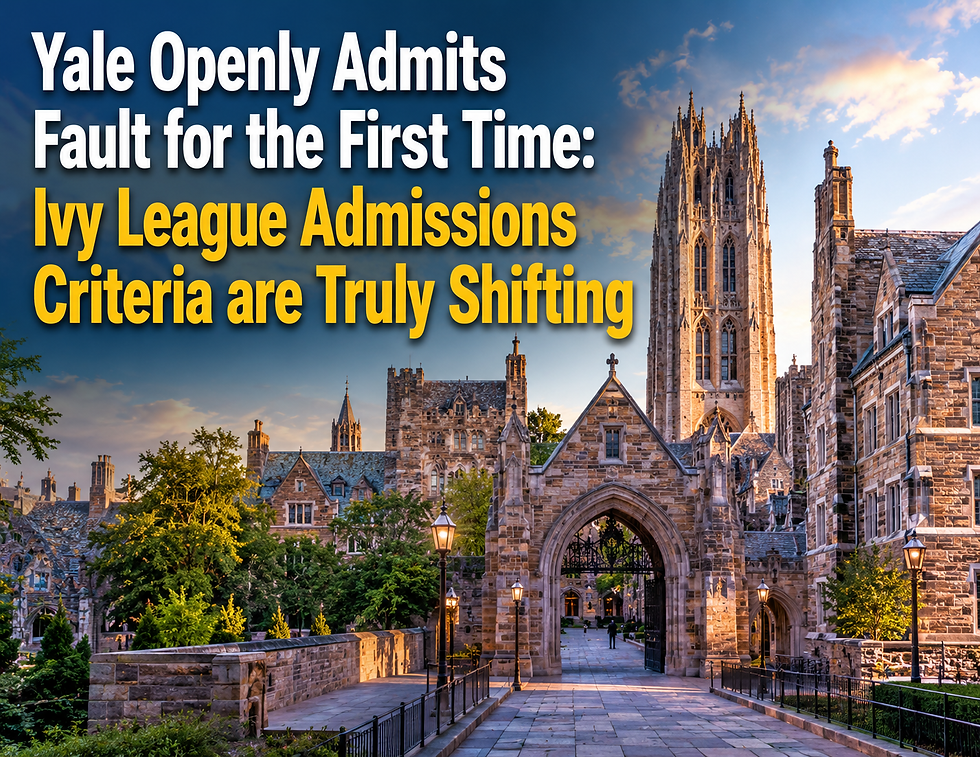
Over the past few years, elite American universities have come under heavy fire. The Atlantic dedicated a ten-thousand-word cover story explicitly declaring that "The Ivies Are Ruining America," while other media outlets added fuel to the fire by relentlessly exposing grade inflation scandals at Harvard and Yale. A 2025 survey by the Pew Research Center also revealed that 70% of Americans believe higher education is headed in the wrong direction—a staggering 14-percentage-point increase compared to 2020.
Editor's Note: Another viral hit from The Atlantic was titled "The Elite College Students Who Can't Read Books," which quickly prompted a fiery rebuttal from the Columbia Daily Spectator. This ongoing battle of words has been fascinating to watch.
Historically, the Ivy League shrugged off public backlash without ever looking back—until this year.
Ivy League Admissions Criteria are Truly Shifting
In January, Dartmouth College President Sian Beilock penned an op-ed in The Wall Street Journal, bluntly asking: "Is a Four-Year Degree Still Worth It?" In the article, she openly admitted that American universities are facing a "crisis of trust," writing, "Addressing it must start by lowering tuition." Yet, paradoxically, Dartmouth’s total cost of attendance for the 2025–26 academic year has already climbed to $95,490. When you factor in mandatory health insurance and other fees, the actual out-of-pocket expense has easily cleared the $100,000 threshold.
Then, a scene unfolded that absolutely no one anticipated: Yale University voluntarily stepped into the witness stand.
In April, Yale’s president issued a letter to the entire university community, opening with a striking line: "We are by no means mere bystanders." Attached to this letter was a 58-page report, meticulously compiled over the course of a year by a committee of ten professors. The report pulled no punches, taking direct aim at "grade inflation, opaque admissions, ideological homogeneity, and exorbitant tuition."
One by one, Yale stripped away the four core fig leaves protecting the Ivy League's reputation. What makes this truly rare is that Yale is the very first Ivy League institution to engage in public self-criticism to this extent. So, what exactly did Yale confess to?
What Exactly Did the Ivy League "Get Wrong"?
To understand how we got here, we have to look back to April 15, when Yale University President Maurie McInnis emailed the entire campus. The core message of her letter boiled down to a single sentence: "The committee asks Yale to reflect on and take responsibility for our role in the erosion of public trust. I fully accept this judgment. This decline did not appear out of thin air, nor did it happen overnight. We are by no means mere bystanders."
The attached 58-page document, titled The Report of the Committee on Trust in Higher Education, outlined 20 reform recommendations covering almost every facet of the university—including admissions, grading, tuition, and free speech. Every single recommendation cut straight to the Ivy League's lifeline.
Yale’s report essentially accepted all the criticisms leveled against it by outsiders, confirming them point by point.

1. Grade Inflation
First up was grade inflation. A 2023 study by Yale economics professor Ray Fair revealed that a staggering 78.97% of Yale students received an A or A-, compared to a mere 10% in 1963. In other words, an "average student" at Yale today is pulling in grades that only the absolute top tier could achieve sixty years ago. To combat this, the committee recommended anchoring the average undergraduate GPA to 3.0 and appending percentile rankings to transcripts so that grades actually reflect academic distinction again.
Of course, "grade culture inflation" is hardly unique to Yale. Internal data from Harvard in 2025 showed that 60% of undergraduate grades awarded were straight A’s, and 84% fell in the A or A- range. In response, Harvard introduced its strictest-ever grading cap this February: A-grades will be capped at 20% of the class plus an additional four students, set for full implementation in the 2027–28 academic year.
The announcement caused an absolute uproar among students. While some supported it, others launched a petition opposing the rule, claiming the policy was "racially discriminatory," causing the vote to be indefinitely postponed. Meanwhile, Princeton is in a similar boat. In the 2024–25 academic year, the proportion of A-range grades reached 66.7%, a 20-year high. Yet, while Harvard and Yale engage in soul-searching, Princeton’s dean responded this past February by stating they have "no plans" for reform.
2. Opaque Admissions
Next is the black box of admissions. Yale’s acceptance rate for the Class of 2030 plummeted to 4.2%, but the issue isn't the fierce competition itself—it’s whether the playing field is level. The report cited a landmark study by Harvard economists Raj Chetty, David Deming, and John Friedman, which found that applicants from the top 1% of the income bracket are more than twice as likely to gain admission to elite private colleges than middle-class students with identical academic credentials.
Legacy preferences, donor relationships, and athletic recruitment are the primary drivers of this disparity. The report recommended that Yale clearly publish its admissions criteria—such as minimum SAT benchmarks—and be "willing to publicly describe and comfortably defend" whatever standards it uses.
3. Ideological Homogeneity
Then there is the issue of intellectual echo chambers. A 2025 internal survey at Yale showed that one-third of undergraduates felt they could not freely express their political views on campus, compared to just 17% in 2015. In a single decade, the rate of self-censorship has nearly doubled. The report also pointed out that the ratio of Democrats to Republicans among Yale’s faculty stands at an astonishing 36:1, noting that "a campus dominated by a single narrative will not produce the best research and teaching."
4. Exorbitant Tuition
Finally, the report tackled the most sensitive topic: skyrocketing tuition. Yale’s total cost for the 2025–26 academic year sits at $94,425, while the median American household income is under $84,000. A nationwide survey showed that 86% of respondents view Yale as "too expensive." More awkwardly, even though Yale possesses a robust financial aid system, nearly half of the American public simply does not believe that aid of this magnitude actually exists.
Fortunately, this past January, Yale announced that it would waive tuition for families making under $200,000 and provide full financial coverage for those earning under $100,000, starting with the incoming class in the fall of 2026.
Redefining the University's Mission
The report went a step further by proposing a fundamental change: rewriting Yale’s mission statement.
Three specific phrases are set to be expunged from the current statement: "improve the world today," cultivating "aspiring leaders," and fostering an "ethical, interdependent, and diverse community." In their place, Yale will reinstate a line that has long existed in its faculty handbook: "to create, preserve, and disseminate knowledge through research and teaching."
The committee explained: "These are all worthy pursuits, but they are not the essence of what makes a university a university."
Let's pause and think about that for a moment. The phrase "cultivating aspiring leaders" is splashed across the recruitment brochures of almost every top-tier university, and it serves as the opening hook for countless application essays. It is the core narrative of elite education, and the precise justification whispered by countless parents sending their children abroad.
Yet, Yale just crossed it out with its own pen.
This doesn't mean leadership is trivial. Rather, Yale has realized that when a university views "building leaders" as its sole raison d'être, it completely loses sight of its priorities. A university is not a star-making factory or a mere trampoline into the global elite; its fundamental duty is to ensure knowledge is created, passed down, and preserved.
This cut runs incredibly deep. It is not just a change in slogan; it is an outright dismantling of the foundational logic that has underpinned elite education for decades.
Dismantling the "Ivy League Formula"

When you piece all these developments together, a clear trend emerges: the Ivy League is actively tearing down the old rules of the game and redefining exactly what kind of student it wants to recruit. Ironically, many of the standardized "Ivy League formulas" widely circulated among international applicants are the exact practices called out in this report. Ivy league admissions criteria are truly shifting
The Weight of Genuine Academic Ability Is Rising. This doesn't mean academics didn't matter before, but the report explicitly advocates for diminishing the influence of "non-academic factors" like legacy status, donor connections, and athletic recruitment, while pushing for transparent academic baselines. In other words, the space for gaming the system through family background and networking is shrinking. For the vast majority of international applicants, this is actually a positive signal: authentic academic merit will hold more weight than ever before.
Moving Beyond the "Quantified Mindset." In the report, "academic ability" does not mean hoarding AP courses. The committee strongly criticized the current "quantified mindset" in college admissions—the practice of evaluating a human being solely by standard test scores, the sheer volume of advanced classes, or a laundry list of extracurricular activities. Moving forward, Yale likely wants to see students who are willing to take intellectual risks in the classroom and who possess a profound, genuine commitment to a specific field, rather than heavily engineered, "industrialized" applicants with artificially padded resumes.
Liberal Arts Thinking as a Core Competency. When discussing classroom reform, the report explicitly calls for an environment where "open inquiry and intellectual debate flourish." The logic here is clear: in the era of AI, technical skills can easily be replaced, but interdisciplinary comprehension, critical thinking, and the ability to view a problem through multiple lenses remain areas where algorithms cannot compete. The Yale report appropriately quotes John Stuart Mill: "Truth is a many-sided jewel... it is only by the collision of adverse opinions that the remainder of the truth has any chance of being supplied." This signals a shift in what will be expected of future applicants: Do you have the capacity to form your own independent worldview, and do you have the maturity to refine it when challenged by opposing perspectives?
Furthermore, the report highlighted public service, foundational scientific research, education, healthcare, and the arts as the career paths Yale takes the most pride in for its graduates—conspicuously leaving out investment banking, management consulting, and Big Tech. This isn't to say Yale looks down on high-paying corporate roles; rather, it means that if an applicant’s entire narrative is built around a mercenary logic of "getting into a top school to secure a high-paying job for status," admissions officers can spot it from a mile away. This marks a return to the true essence of elite education: attending university isn't about chasing institutional prestige; it's about finding work you would passionately pursue even if the prestige vanished tomorrow.
When it comes to "intellectual independence," the report repeatedly circles back to a single phrase: "intellectual risk-taking."
Yale's internal survey showing that a third of its students are afraid to voice their true political opinions manifests in application essays as a sea of safe, sanitized, harmless narratives along the lines of "I love community service" and "I learned the value of teamwork." They are perfectly readable, but they are entirely forgettable.
Yale wants to see the student who is brave enough to take a definitive stand on a complex issue and possesses the intellectual stamina to defend it.
There is a line in the report that serves as a perfect mirror for future applicants: Yale aims to use admissions standards that it is "willing to publicly describe and comfortably defend."
The ultimate question for the next generation of students is simple: Can you publicly describe who you are, and do you have the courage to comfortably defend yourself?
Yale Will Not Be the Only University to Reconsider Its Path
Why was Yale the first to break ranks and speak out?
The answer likely lies in its institutional DNA. In 1974, following a wave of intense campus protests, then-Yale President Kingman Brewster commissioned the legendary historian C. Vann Woodward to lead a committee that ultimately produced the Report on Freedom of Expression at Yale. That document became the gold standard for free speech policies across American academia and was adopted by dozens of universities.
Fifty years later, this new report—which is currently sending shockwaves through the educational world—opens by directly quoting the core tenets of the Woodward Report. This is Yale’s historic tradition: transforming an internal crisis into a landmark philosophical text that reshapes the entire landscape of higher education.
Yale may be the first to step forward, but it certainly will not be the last.
In Kazuo Ishiguro’s novel An Artist of the Floating World, a poignant line reads: "When we look back across our lives, seeing their successes and flaws, what matters is that we cared."
In 1974, Yale asked a profound question about the boundaries of free speech, and the resulting report shaped an entire generation's understanding of campus discourse. Fifty years later, it has stepped forward to ask an even bigger question. This time, it is asking: What, ultimately, is a university for?
This is a question that does not belong to Yale alone, nor is it confined to the United States. As long as educators and students continue to grapple with it honestly, the definitive answer remains unwritten.
**Want to Learn More About Our Programs? **
Feel free to contact us through the following channels:
Official LINE: @panoedu
Phone: 02-8771-3190 / 0912-090-325
、


Comments