.png)
MIT Releases Its Recommendation Letter Guide: From Praise to Proof—What Top Universities Really Want to See

Translated from original Chinese article: https://mp.weixin.qq.com/s/IKkkyyx1APlj0OxKiW975Q
In the U.S. college admissions process, recommendation letters are often one of the most underestimated application components.
Students can use their essays to discuss their interests, experiences, and personal growth. However, recommendation letters offer something different: a third-party perspective.
A teacher who truly knows a student can provide insight into how that student asks questions in class, responds to challenges, collaborates with peers, and performs under pressure. These observations often carry more weight than a simple statement that "this student is excellent."
MIT makes this point very clearly in its recommendation letter guide for teachers and college counselors. Because the applicant pool is highly competitive, recommendation letters carry substantial weight in admissions decisions. A strong recommendation can reveal qualities that students cannot fully communicate through self-description alone. Let's examine what top universities really want to see.
What Does a Strong Recommendation Letter Look Like to MIT?
MIT's definition of an effective recommendation letter is straightforward: the most helpful letters are "specific and storied."
In other words, they are:
Specific
Rich in anecdotes
Grounded in real situations
Supported by evidence
The letter should provide information and impressions that cannot be found elsewhere in the application. Whenever possible, evaluations should be backed up with concrete facts and examples.
This means a recommendation letter should not simply say:
This student earns excellent grades.
This student works hard.
This student is responsible.
While these are positive comments, they carry limited value without supporting evidence. Admissions officers need context to understand what these statements actually mean.
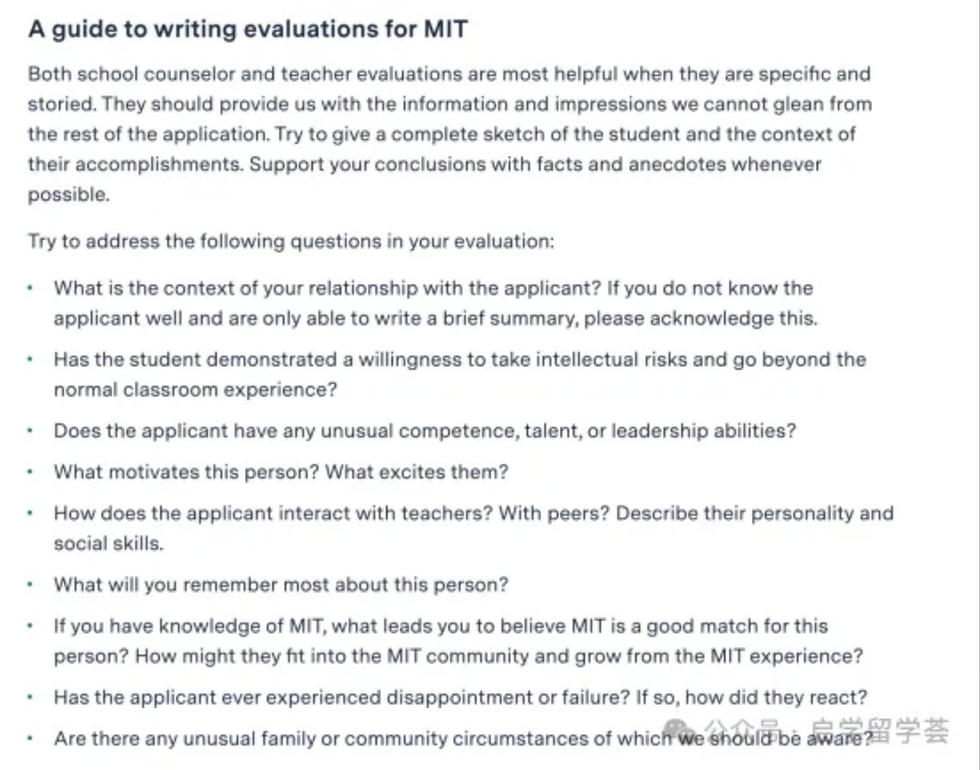
MIT encourages recommenders to consider questions such as:
Does the student take academic risks and go beyond basic classroom expectations?
What unique talents, strengths, or leadership qualities does the student possess?
What motivates and excites the student?
How does the student interact with teachers and classmates?
Has the student experienced setbacks, and how did they respond?
If the recommender knows MIT, why would this student be a good fit for the MIT community?
Notice that almost none of these questions focus on GPA or test scores.
This reveals an important truth: MIT is not looking for a recommendation letter that simply confirms academic achievement. Instead, it wants an observational report that captures how a student learns, thinks, collaborates, and grows.
The Most Common Recommendation Letter Mistakes

Mistake #1: Using Adjectives Without Evidence
One of the biggest mistakes is relying on praise without providing examples.
MIT shares the example of a student named Jen. Her recommendation letter described her as a good student, honest, and trustworthy. The teacher also mentioned that Jen once pointed out a grading mistake that actually lowered her own score.
Although the letter contained positive comments, MIT noted that it lacked depth and failed to make the applicant more competitive.
Why?
Because qualities like honesty, diligence, and responsibility are admirable—but they are not rare among highly qualified applicants.
Without detailed examples that reveal something unique about the student, the letter does little to distinguish them from thousands of other strong candidates.

Mistake #2: Repeating Information Already Found Elsewhere
Another common problem is using the recommendation letter to summarize grades and rankings.
MIT provides an example of a letter describing a student named Brian as:
Consistently ranked near the top of the class
Highly motivated
Hardworking
Possessing above-average reasoning skills
At first glance, these seem like strong endorsements.
However, MIT's critique was blunt: after reading the letter, admissions officers still do not know what the teacher is actually trying to communicate about the student.
MIT specifically advises recommenders to go beyond academic performance, because grades, course rigor, and rankings are already available elsewhere in the application.
If a recommendation letter simply repeats information from a transcript, it contributes very little new insight.

Mistake #3: Choosing a Recommender Who Barely Knows the Student
MIT also provides an example involving a school counselor who admitted that they did not know the student particularly well and could only rely on feedback from other teachers.
Interestingly, MIT viewed this honesty positively. Admissions officers at least understood why the letter lacked detailed information.
This highlights an important lesson for applicants:
When choosing recommenders, the most important factor is not status or title.
The key question is:
Does this person know you well enough to write specific, detailed observations?
A teacher who can tell meaningful stories about your growth and character is often far more valuable than a prestigious recommender who barely knows you.
How Recommendation Letters Can Strengthen an Application
Use Stories to Demonstrate Ability
MIT highlights the example of a student named David, whose recommendation letter was particularly effective.
Instead of simply stating that David was strong in mathematics, the teacher provided specific evidence:
David took AP Calculus as a sophomore and ranked among the strongest students despite being surrounded by older classmates.
He demonstrated a long-term interest in computer science by developing educational software for algebra and arithmetic practice.
He conducted research, published papers, and presented his work to professionals.
He even took over his teacher's programming class for a period of time, preparing lectures, assignments, and assessments himself.
MIT praised this recommendation because it showed that the teacher genuinely knew the student.
More importantly, it illustrated David's:
Intellectual ability
Initiative
Maturity
Leadership
Resourcefulness

The difference is clear:
"Strong in mathematics" is an opinion.
"Excelled in an AP Calculus class filled with older students" is evidence.
"Interested in computer science" is an opinion.
"Developed educational software, conducted research, and presented to professionals" is evidence.
"Has leadership skills" is an opinion.
"Designed and taught a programming course independently" is evidence.
Powerful recommendation letters transform abstract praise into concrete examples.
They help admissions officers understand not just what a student has achieved, but why those achievements matter.
Provide Context for Academic Performance
MIT's example of a student named Jane illustrates another important role of recommendation letters.
Sometimes, recommendation letters can help explain circumstances that are not immediately visible in an academic record.
Jane's transcript did not fully reflect her academic potential. Her teacher explained that she had experienced significant family challenges during high school, including parental divorce, ongoing family conflict, and her father's struggle with alcoholism.
The recommendation letter also noted that once her family situation stabilized, her grades improved substantially.
MIT explicitly states that this type of contextual information can be valuable because it helps admissions officers understand the environment in which a student achieved their results.
For many applicants, this is an important reminder:
Recommendation letters are not only for highlighting strengths. They can also provide context for fluctuations in grades, periods of difficulty, or personal growth.

However, there is an important distinction.
Effective context is not the same as making excuses.
The strongest explanations include three elements:
What challenge occurred
How it affected the student
How the student adapted, recovered, or grew
This approach allows admissions officers to see not only the obstacle itself but also the student's resilience and development.
What Top Universities Really Want to See
MIT's recommendation letter guide reveals a broader admissions philosophy.
Top universities are not simply trying to determine whether a student is impressive.
They want to understand how that student is impressive.
Strong grades demonstrate academic preparation.
A recommendation letter should reveal curiosity, initiative, and a willingness to pursue learning beyond classroom requirements.
Strong extracurricular activities show what a student has done.
A recommendation letter should reveal how that student behaves in collaborative settings, whether others trust them, and whether they positively influence those around them.
A compelling personal essay shows how a student views themselves.
A recommendation letter should confirm whether that self-portrait aligns with how others experience them.
Ultimately, MIT is not looking for a perfectly polished applicant.
It is looking for students who possess genuine intellectual curiosity, initiative, resilience, and a sense of community—and whose character can withstand independent observation.
This serves as an important reminder for students and families.
Recommendation letters are not something to think about only during application season. The strongest letters emerge naturally from years of classroom engagement, thoughtful questions, meaningful teacher relationships, and consistent effort.
How a student learns, collaborates, responds to setbacks, and contributes to a community eventually becomes the most persuasive evidence a teacher can provide.
If a personal essay answers the question, "How do I see myself?", then a recommendation letter answers a different question:
"How do the people who know me best see me?"
When those two perspectives reinforce one another, an application becomes far more compelling.
**Want to Learn More About Our Programs? **
Feel free to contact us through the following channels:
Official LINE: @panoedu
Phone: 02-8771-3190 / 0912-090-325
、


Comments