.png)
The Different Types of Undergraduate Degrees
- JC Guedon
- 17 hours ago
- 4 min read

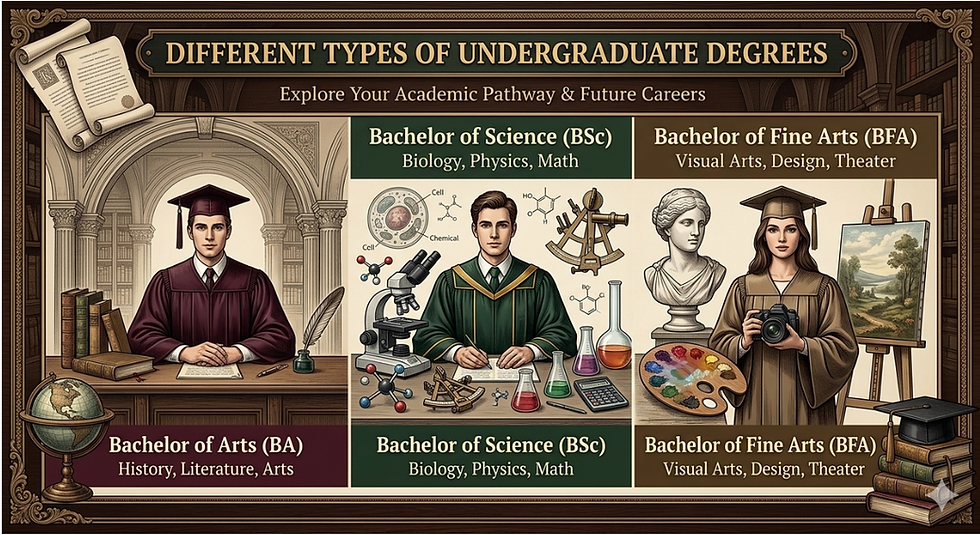
Choosing an undergraduate degree is one of the most significant milestones in your academic journey. While higher education offers dozens of specialized fields, the majority of undergraduate programs fall into three core categories: the Bachelor of Arts (BA), the Bachelor of Science (BSc), and the Bachelor of Fine Arts (BFA). Understanding the unique focus, curriculum design, and career outcomes of each degree will help you align your academic strengths with your professional goals. Let's examine the different types of undergraduate degrees
🎓 Types of Undergraduate Degrees: The Undergraduate Major Breakdown
Degree Type | General Field | Popular Majors |
Bachelor of Arts (BA) Focus: Qualitative & Humanities | 🏛️ Humanities 🌍 Social Sciences 🗣️ Languages | • English Literature, History, Philosophy • Political Science, Sociology, Psychology • Linguistics, Global Studies, Communications |
Bachelor of Science (BSc) Focus: Quantitative & Technical | 🔬 Natural Sciences 💻 Tech & Math 🌿 Earth Sciences | • Biology, Chemistry, Physics, Neuroscience • Computer Science, Data Analytics, Statistics • Environmental Science, Geology, Meteorology |
Bachelor of Fine Arts (BFA) Focus: Creative & Studio-Based | 🎨 Visual Arts 🎬 Performing Arts 📐 Design & Media | • Painting, Drawing, Sculpture, Photography • Acting, Musical Theater, Dance • Graphic Design, Film Production, Animation |
1. Bachelor of Arts (BA): The Liberal Arts and Humanities
The Bachelor of Arts is a versatile degree that emphasizes a broad, well-rounded education. It is typically rooted in the humanities, social sciences, and liberal arts.
Core Focus and Curriculum
BA programs prioritize critical thinking, effective communication, and cultural awareness. Compared to more specialized degrees, a BA offer immense flexibility. Students often have the freedom to choose from a wide variety of elective courses outside their major.
Common Majors: History, English Literature, Sociology, Philosophy, Political Science, and Foreign Languages.
Skill Development: Qualitative research, persuasive writing, analytical reasoning, and intercultural communication.
Who is it for?
The BA is ideal for students who love exploring complex social issues, reading deeply, and analyzing human behavior. It is also an excellent option for those who want a flexible degree that leaves the door open to multiple industries.
2. Bachelor of Science (BSc): The Technical and Analytical Pathway
The Bachelor of Science focuses heavily on technical, mathematical, and scientific disciplines. It trades the broad exploration of a BA for a deeply focused, quantitative approach.
Core Focus and Curriculum
BSc programs are highly structured, requiring rigorous coursework in laboratories, data analysis, and mathematics. The curriculum is designed to help students master technical methodologies and apply the scientific method to solve concrete problems.
Common Majors: Biology, Physics, Chemistry, Mathematics, Computer Science, and Data Analytics.
Skill Development: Quantitative analysis, statistical modeling, laboratory research techniques, and technical problem-solving.
Who is it for?
If you possess strong analytical skills, enjoy working with numbers, and want to understand how things work on a molecular, physical, or algorithmic level, a BSc is the logical choice. It provides a direct pipeline to technical roles and research fields.
3. Bachelor of Fine Arts (BFA): The Intensive Path for Creatives
The Bachelor of Fine Arts is a professional degree specifically designed for students pursuing a serious career in the visual, performing, or literary arts.
Core Focus and Curriculum
Unlike BA and BSc programs, which balance major requirements with general education classes, a BFA is an intensive, studio-based degree. Up to two-thirds of the curriculum is dedicated to practical, hands-on artistic creation, studio time, and critiques.
Common Majors: Visual Arts, Graphic Design, Theater, Film Production, Painting, and Photography.
Skill Development: Creative execution, technical mastery of artistic mediums, portfolio development, and constructive peer evaluation.
Who is it for?
The BFA is a highly rigorous program suited for passionate creatives who want to immerse themselves fully in their craft. Admission often requires a competitive portfolio review, audition, or interview.
Comparative Summary: BA vs. BSc vs. BFA
To help you visualize how these three pathways stack up, here is a breakdown of their primary differences:
Feature | Bachelor of Arts (BA) | Bachelor of Science (BSc) | Bachelor of Fine Arts (BFA) |
Primary Scope | Humanities & Social Sciences | Science, Tech, & Math | Visual & Performing Arts |
Approach | Qualitative & Theoretical | Quantitative & Empirical | Practical & Studio-Based |
Flexibility | High (Many electives) | Moderate (Structured) | Low (Highly specialized) |
Key Outcome | Critical Thinking & Literacy | Technical Mastery & Logic | Professional Portfolio |
Career Outcomes and Future Outlook
Each degree unlocks distinct career pathways, though the boundaries are increasingly fluid in today's cross-disciplinary job market.
BA Graduates: Often find success in fields like journalism, public relations, law, public policy, marketing, and human resources. Their adaptable skill sets make them highly resilient to shifting job markets.
BSc Graduates: Enter high-demand sectors such as software engineering, data science, environmental research, biotechnology, and financial analysis. This degree also serves as the traditional foundation for medical school.
BFA Graduates: Step directly into creative industries as commercial designers, fine artists, art directors, theatrical performers, or filmmakers. Many also build successful careers as freelance creative consultants.
Other Common Bachelor Degrees
BBA (Bachelor of Business Administration): Strictly focused on business, finance, and management principles.
BMus (Bachelor of Music): Highly specialized, audition-based degree for musicians.
BArch (Bachelor of Architecture): A rigorous, often 5-year degree required to become a licensed architect.
BAS (Bachelor of Applied Science): Bridges the gap between a technical and a practical applied degree, often geared towards students with an associate degree looking to advance in a specific technical career.
BA vs BS in Math and Science Comparison:

**Want to Learn More About Our Programs? **
Feel free to contact us through the following channels:
Official LINE: @panoedu
Phone: 02-8771-3190 / 0912-090-325
、



Comments